
When Manchester alt-rock trioFalse Advertisingreleased their last albumBrainfreezein 2019, it felt like the culmination of five relentless years: SXSW appearances, festival slots at 2000 Trees (twice), a trusted team of label, manager and agent, and the kind of growing buzz most DIY bands dream about.
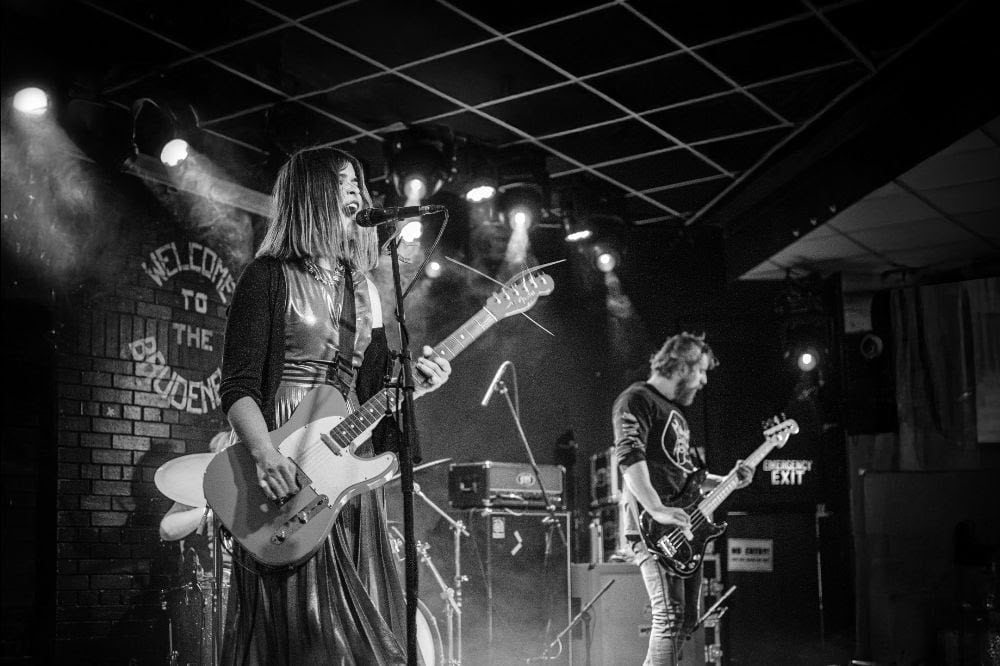
Then, almost as soon as the record landed,everything stopped.
The COVID-19 pandemic hit, touring vanished overnight, and the carefully built momentum around the band evaporated. What followed was a long, stop–start period of writing, self-doubt, lineup changes and quiet graft that eventually birthed their new albumThe Sorry Window– a record Jen Hingley describes as both a “labour of love” and a kind of reset button.
“I think it does feel like we’re starting from nothing again,” she says. “We’d worked so hard and achieved so much we were proud of, and then we lost all that momentum. At a certain point, I had to let go of any expectation of how this album ‘should’ do, just to stay sane.”
Yet despite the chaos behind it,The Sorry Windowhas found an audience – and crucially, it’s revealed just how much Hingley has grown, not only as a songwriter and producer, but as an artist whose visual work has quietly shaped the band from the beginning.
From BrainfreezetoThe Sorry Window: A Long Detour
The story ofThe Sorry Windowbegins whereBrainfreezeleft off. Between 2015 and 2019, False Advertising’s trajectory looked like a textbook “right way” to build a band: write, tour, release, grow, attract the right collaborators.
“We had that classic arc,” Hingley recalls. “Form a band, put music out, gradually build, then eventually work with labels, a manager, an agent. We were really lucky to get to do things like SXSW, 2000 Trees, and recordBrainfreezein a great studio with our producer Luke Pickering, who we still work with.”
By early 2020, withBrainfreezefreshly released but touring impossible, Hingley pivoted hard into writing and recording. Rather than a live, in-the-room band record,The Sorry Windowbecame something else entirely: a patient, solitary build. She wrote and recorded most of the songs herself, often playing every instrument except bass. Collaborators – Luke on production, Josh on bass, and contributions from former member Chris – fed in remotely and intermittently. COVID and isolation meant no easy rehearsals and no quick live takes; everything was layered, refined and revisited over time.
“If you’ve got three people playing together in a room, it happens a lot quicker,” she says. “When it’s one person playing each thing individually, over years, going back and forth through Covid, of course it’s going to take longer.”
By the time the album was essentially finished, they were in 2023. The band that existed in 2019 – with full team, stable lineup and steady touring – no longer really existed.
Losing Momentum, Letting Go
False Advertising didn’t just lose time; they lost infrastructure. Chris left the band on good terms after an “awesome run of dates.” Their manager and agent were no longer in the picture. Even the basic logistics of live shows – like who actually drives the van – became more complicated. They did attempt live dates with drummer Lucy Brown, including festival slots and a memorable headline show in Lincoln where fans formed a human tower and stagedived – “one of my favourite gig experiences of all time,” Hingley smiles – but it still felt like they were pushing against a wall.
“Live just didn’t fully make sense at that moment,” she admits. “It felt like we’d lost all our momentum. Releasing the album felt like the best way to create focus again, to build to a point where live shows would make more sense in the future.” That long limbo changed Hingley’s relationship with the very idea of success. At the start of the process, she carried a heavy internal pressure to honour what the band had already achieved. “I had this weight of expectation,” she says. “Like, we’d all sacrificed so much. If I couldn’t get this album out in a way that built on that, I’d be letting everyone down – the band, myself, everyone who’d believed in us.”
But as the years dragged on, something had to give. “I really did eventually surrender the whole idea of expectation. I still wanted the band to work, still wanted it to continue, but I reached a point of: I just want to put it out. I want it to be presented as well as it can be, I don’t want to stand in the way of its success – but I no longer expect it to ‘do’ anything. Whatever happens, happens.”
That reckoning runs straight through“Next Big Thing”, one ofThe Sorry Window’s standout tracks. The song tackles the absurd pressure on bands to present themselves as the “next big thing,” even when the reality behind the curtain is much messier.
When False Advertising started, they had already accidentally proven to themselves that presenting as something bigger than you are can work. They waited to “exist” publicly until everything was in place. On a single day, they announced the band, released debut single “Wasted Away” and revealed their branding, visuals and a basic website. From the outside, they appeared fully formed. Blogs, industry people and agents quickly took notice. Clever April Fools’ stunts – including a fake billboard for an EP – only added to the aura.
“It wasn’t lying, exactly,” she says, “but we definitely chose how much of the story to show. We presented the most ‘super’ version of ourselves.”
Writing “Next Big Thing” partway throughThe Sorry Window’s long gestation, Hingley realised that kind of posturing didn’t fit anymore. “I just couldn’t see how that approach would work this time. I’d got to this point of wanting to be completely honest about everything. That’s very much how we’ve tried to run this campaign – though even then, there are complications, like old videos still featuring Chris. You can try to be as honest as you can and still get slightly derailed.”
Anxious, But Still Moving
IfThe Sorry Windowhas a thematic spine, it’sself-doubt and anxiety– not as static states, but as forces that warp how you experience opportunities, success and even your own abilities.
“Most of the record is about self-doubt and anxiety,” Hingley says. “It’s about feeling derailed by your own head when you actually have chances to succeed.”
Take“Weak Ties”, one of the album’s most striking departures; a track that leans into electronic textures and a different kind of pacing while still feeling distinctly False Advertising. The song began during a phase when Hingley was forced to write entirely alone, armed with Logic, a small MIDI keyboard and electronic drums. Later, she reintroduced live drums as the track builds to its climax, using the band’s DNA to frame what began as a more electronic experiment.
“‘Weak Ties’ is about anxiety affecting the way you perceive things,” she explains. “It talks about feeling dizzy or disorientated – that kind of distracted state. It’s just another angle on that broader theme of self-doubt that runs through the album.”
Living inside that headspace for so long, across years of work, inevitably took its toll.
“In practical terms, making the album has sometimes made my anxiety worse,” she admits. “Especially recently – staying up late editing videos, answering emails after a full day’s work. Then you try to switch off and sleep, and it’s hard.”
But in the bigger picture, she feels calmer and more grounded than when the process began. “The journey from ambitious expectations to letting things go has definitely helped. I’m an anxious person, and I’m trying to work on that. But I do feel better now than I did in the middle of it.”
Working alone so much, she says, also changed how that internal critical voice behaved. When you’re in a room with bandmates, the questioning is a conversation – you keep each other in check. When you’re alone, that “keeping in check” voice can turn into something harsher and more negative, especially when you’re already under pressure. That’s something she wants to be better with in future.
From Co‑Pilot to Producer
The long road toThe Sorry Windowdidn’t just rewrite Hingley’s emotional relationship with the band; it fundamentally changed hertechnical rolewithin it.
False Advertising began as an almost perfectly symbiotic partnership between her and Chris [Warr – vocals, guitar and drums]: one would sing and write while the other played drums, then they’d switch. Chris handled recording, engineering and mixing. Jen took care of the visual identity – artwork, videos, design.
“We felt like we had the creative bases covered,” she says. “We didn’t need anyone to tell us what to do; we could record, design, release – the whole thing.”
As the band grew, they brought more people into the circle, particularly aforementioned producer Luke, who became a crucial fixture from around 2018 onward. Hingley spent countless hours in studios with him, quietly absorbing the craft of production as they worked.
WithThe Sorry Window, those years of observation finally translated into full participation. Most of the music production and writing on the new album is now handled by her, working closely with Luke. “I would never have been able to offer that side of things at the beginning of the band,” she explains.
One of the key turning points came during the pandemic, when the Church Studios in London reopened briefly and she was finally able to step inside again after months of isolation and remote stem-swapping. She remembers that session vividly: hearing her self-recorded drum parts, now polished and elevated through a proper studio chain; feeling the songs she’d built alone in a rehearsal room suddenly sound real; realising that all the painstaking trial and error – mic placement, gear upgrades, re-takes – had been worth it. “Hearing those tracks back on real studio speakers, and them actually sounding good, kind of broke my brain,” she laughs. “It proved to me it was worth continuing.”
That new skill set has opened other doors too. “There’ve been a couple of times where people have asked if I can add vocals or a guitar solo to something,” she says. “Now I can just go and do the whole thing myself – record, comp, produce – and send back proper, professional stems. That’s really nice.”
The Designer Behind the Band
For all the focus on music, it’s impossible to understand False Advertising without understanding Hingley’svisual career. Long before the band existed, she was already immersed in the intersection of music and design.
As a teenager, she fell in love with bands and the early internet at the same time – hanging out on fan forums and gradually teaching herself how to build websites. Her first big project was a Fightstar fan site calledFightstar Online, which drew her into a broader community around UK bands like Reuben, Biffy Clyro and Yourcodenameis:milo.
That DIY fandom became a career. After university she landed what she calls her “dream job” making band websites at a Manchester company called Retrofuzz, right at the tail end of the MySpace era. As the industry shifted and music budgets shrank, her work expanded into fashion e‑commerce, UX and large-scale digital design, eventually leading to her current role as a lead digital designer with a strong user-experience focus.
That background has always been baked into False Advertising’s DNA. “I was a designer before I formed the band,” she says. “So of course I was going to build the website. Of course I was going to design the artwork and figure out the videos, even if at first I didn’t fully know how.”
Over time she has directed and edited numerous music videos, crafted artwork and the overall visual identity for the band, and built and maintained web presences for artists – at one point including a website forQueens of the Stone Age.
She’s keen to stress that musicians don’t all need to become graphic designers – but she does believe a strong visual sensibility is essential. “It’s a good idea for any band to at least have a sense of the visual side of what you’re doing,” she says. “Even if you’re not taking the photos or designing the artwork yourself, knowing the photographers whose work you love, understanding which visual styles feel right for your music – that helps you carve out an identity and choose the right collaborators.”
For emerging artists, Jen is an example of how a parallel creative career can feed back into a band rather than pull focus from it. A day job in design has given her both the tools to amplify False Advertising’s work and the financial stability to keep making ambitious art without placing all their survival on the band’s shoulders.
The Future of False Advertising
IfBrainfreezewas released into the world with the machinery of a traditional campaign – label support, a touring plan, assumption of demand –The Sorry Windowhas been its opposite: careful, incremental, almost deliberately modest.
Instead of announcing big manufacturing runs and extensive tours, the band has tested the water step by step. Rather than pressing a large run of vinyl up front, they launched acrowdfunding campaignto see if fans actually wanted it. It was fully funded in two weeks, surprising even them. They avoided announcing a tour alongside the album, believing they’d struggle to sell tickets without rebuilding an audience first.
“We haven’t wanted to assume the demand is there for anything,” Hingley explains. “We’d rather create that demand, bit by bit. If we’d announced a tour with the album, I don’t think we’d have sold many tickets. Now, it feels like a good moment to push that side of things – and I’m hopeful we can figure it out.”
So what does thefutureof False Advertising look like from here? Live shows are very much on the table. “We’d love to do live dates,” she says. “We are talking about it. Releasing the album has already helped focus things, and I’m really hopeful we can make it work.” There is more content from theSorry Window era waiting in the wings: the band has stockpiled videos and live recordings over the last six years, much of which is still to be released. And more broadly, Hingley talks about a slow, organic rebuild, where each step leads naturally to the next – crowdfund success allowing vinyl, vinyl and streams suggesting there’s still an audience, which in turn justifies live plans. “We’re figuring it out as we go along,” she says. “In an ideal world we’d have had everything lined up – album, vinyl, tour, the lot – but that just wasn’t realistic this time. So we’re letting each step lead naturally to the next.”
Whatever happens commercially,The Sorry Windowalready stands as a quietly remarkable achievement: a document of a band refusing to die in the dark, of an artist learning new skills mid-flight, and of a creative life that, rather than splitting between “day job” and “music,” lets each side strengthen the other.
“I still want to be a musician. I still want the band to continue,” Hingley says. “But we’re starting again. Whatever happens now, happens. And I’m really grateful people are listening.”