

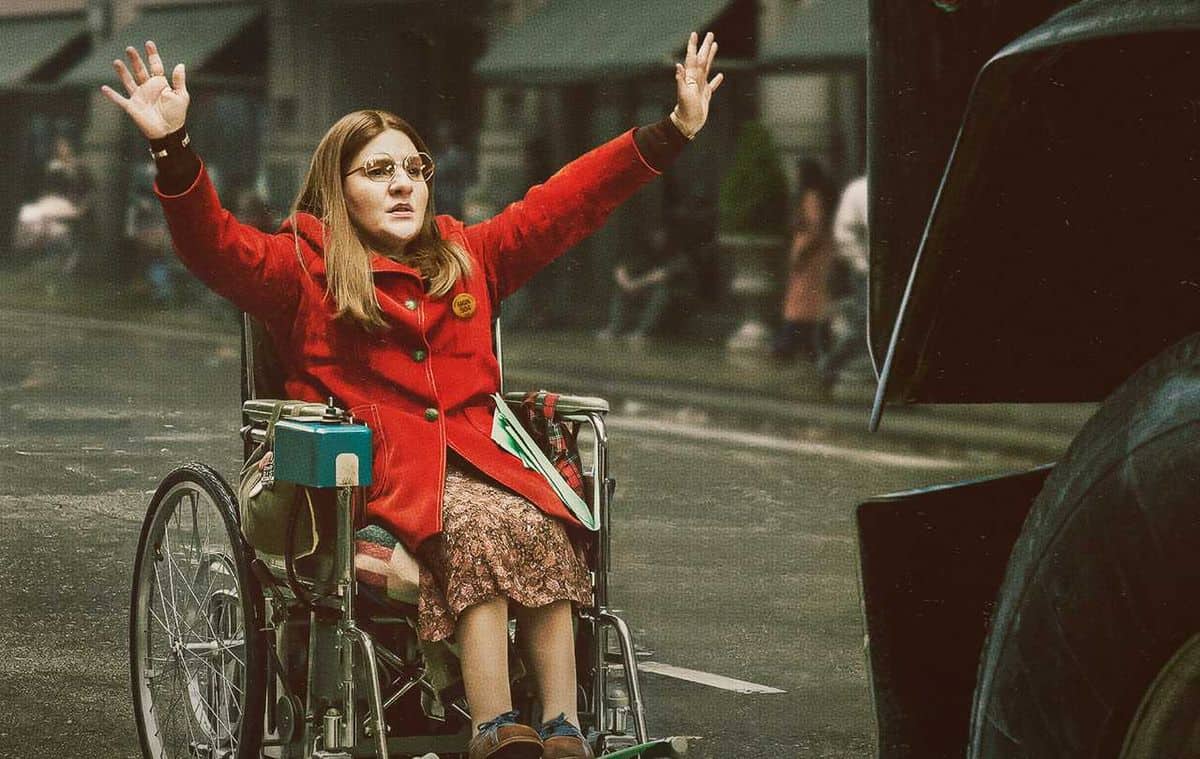
American disability rights activist Judy Heumann was a force to be reckoned with. Known as the “Mother of the Disability Rights Movement,” she was a lifelong civil rights advocate for people with disabilities. It’s no wonder then her memoir, Being Heumann: An Unrepentant Memoir of a Disability Rights Activist, attracted the attention of director Siân Heder, (known for her Oscar-winning film, Coda).
The film, which was a highlight at the AFI Film Fest. covers a pivotal moment in Heumann’s life when, in 1977, she led a 28-day occupation of San Francisco’s Federal Building in a passionate fight for equal rights and accessibility laws.
“The first meeting I ever had with her, I said, ‘you know, this is the seminal moment in disability rights history in this country, and if we’re gonna tell this story, it needs to be told with disabled talent,” Heder said at a recent press event. “We need to do it with authentically disabled actors, and we need to figure out how that’s gonna happen on a movie set.”
Many of the disabled actors working on set had never acted before, and Heder did everything she could to make sure all of their individual needs were met.
‘We were trying to figure out how to create a set where you’re accommodating not just wheelchair users, but blind people, deaf people, little people, people with intellectual disabilities. And every wheelchair user is different. The needs of people’s bodies are different. Some people can transfer themselves. Some people are ambulatory. Some people need two people to transfer them.”
Heder had a very experienced production team who were up for the challenge.
“I will honestly say we were all pretty thrown and daunted by the task at hand…how do you communicate with the accessibility department and know how long a bathroom break is gonna take when you’re transferring someone out of a vintage wheelchair into their (current) chair? Everyone takes a different amount of time, so it’s not like, ‘oh, we’re turning cameras around and we can just know that it takes __ amount of time.”
Thankfully, people rose to the occasion, and everybody adapted and improvised and found a way through, Heder noted. “And while at times it was really messy, it was beautiful to watch the creativity that came out of that process.”
The dynamic Ruth Madeley, who may well be the first actress in a wheelchair to receive an Oscar nomination, was fantastic as the tireless activist. She appreciated one of the lines in the film, where Heumann was talking to someone who called her work inspiring. And her response is, “inspired to do what, or just inspired?”
“I was born with my disability, and I’ve been called inspirational for very un-inspirational reasons,” acknowledged Madeley. “So that line in particular as a disabled person really, really struck me. And it’s so nice to see how much it resonated with so many people, disabled and non-disabled.”
Judy wanted people (not only) to be inspired, but to do something that makes a difference in the world, Madeley said.
“Don’t just be inspired at the fact that we are disabled and we’ve stormed this building in our world and that’s really brave. She wanted people to be inspired because of the reason that they stormed the building.”
Madeley was immensely moved by Heumann’s story; “you so rarely get the opportunity to be a whole human, with all the flaws and mistakes and vulnerabilities that every single other person has.”
The British actress was equally inspired at what laws Heumann got changed.
“I think the power that she had as this tiny little woman from Brooklyn, the fact that she got the government to spend two and a half billion dollars–that for me was the inspiration or takeaway; the power that she didn’t realize that she held. I took her with me through the whole thing.”
What was special about Judy was that she wasn’t perfect, which made her more relatable to people, Madeley noted.
“And the reason this law got passed was because of how she was and how she went about things. And she just refused to relent. And I think so often, disabled characters can be written in a really sterilized way. They can be desexualized, infantilized. They’re either seen as saintly or bitter and depressed, and then they turn into the villain.”
Madeley loves the fact that Heder picked this particular moment in history to tell the story, since Heumann had such a big life.
“You could literally write a movie about any part of her life,” she said. “But this particular moment was before she became the polished leader that she went on to become in the Obama administration, the Clinton administration. She was learning. And I think that being able to show that onscreen, and how it’s not always perfect, and it can be really messy is just all the more powerful.”
During the press chat, Madeley also discussed the differences between disability access in America and in Britain, comparing the areas as similar.
“There’s a lot of planning and negotiating that goes on when you have to navigate the world as a disabled person,” said Madeley. “I would say that it’s quite similar. And I think the UK, there’s conversations as well about disability benefits and the reform that needs to be done with that.”
She continued: “Access and lack of access is quite similar in both, I would feel. Especially in the old parts of wherever you live. London is a nightmare. And that’s our capital. I could never live in London. I would go crazy!… I live up in the north, which I would say I’ve kind of built my own little world…I know where to go where access is good.”