

Originally published in Uncut, September 2010.
Retreat to the West Highlands of Scotland and find PAUL McCARTNEY. Here he works the land, dodges the long-distance brickbats from his old bandmates and embarks on his own, homebrewed solo career. “I needed to get back to ‘me’,” says McCartney. “I’d got too far away from who I was.”
IN OCTOBER 12, 1969, out of the blue, a Detroit radio station began announcing that Paul McCartney was dead. The shock claim was picked up by coast-to-coast newspapers and conspiracy theorists, who scoured Beatles lyrics and photographs for evidence. A theory was put together: McCartney had been killed in a road accident three years before (“he blew his mind out in a car”) and was now being impersonated by a lookalike. The bizarre ‘Paul Is Dead’ myth crossed the Atlantic, becoming a nightmare for Apple, whose Savile Row offices were besieged by hysterical callers. In his book, The Longest Cocktail Party, former Apple employee Richard DiLello called the story “the biggest pain in the ass of 1969”. The media clamoured for a comment from McCartney (or at least from the lookalike). But where was McCartney? Not at his home in Cavendish Avenue, St John’s Wood. Not in Savile Row. DiLello’s book records a conversation at Apple that autumn: “Haven’t seen Paul for a while, have you?” “No, I haven’t seen him for weeks now, and somehow I don’t think we’re going to be seeing much more of him either.”
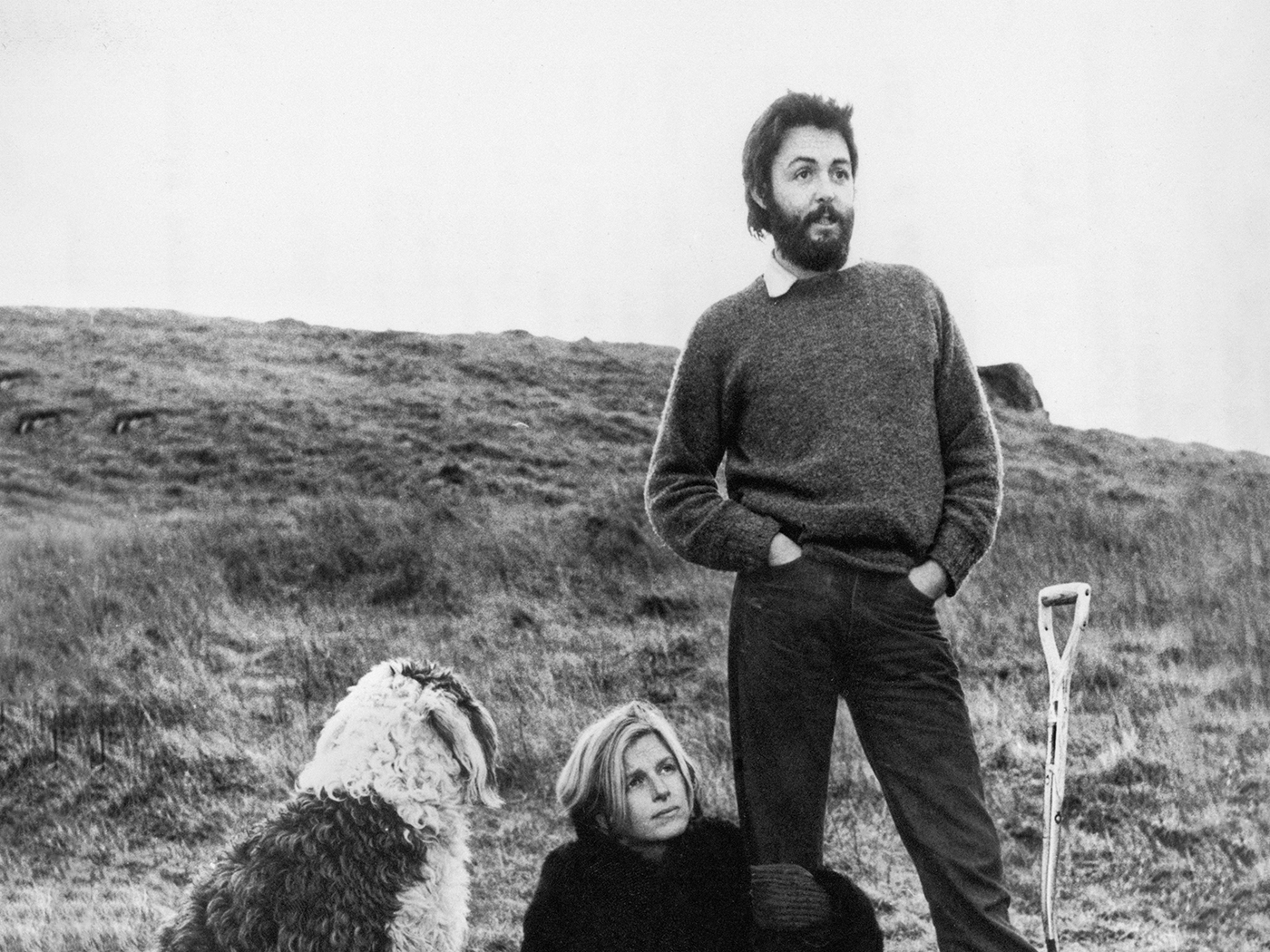
Faint whine of bagpipes. A West Highland mist clears to reveal a 27-year-old bassist chopping firewood, watched from a farmhouse window by his wife Linda, holding their two-month-old baby. Paul McCartney was getting away from it all. “The Beatles had become a painful subject because of all the business shit,” he explains. “I’d been in Savile Row every day, trying to make sense of it, trying not to have Allen Klein as our manager, and being outvoted every time, three to one. Then the lightbulb went off in my head: ‘I won’t go in any more.’ Linda and I withdrew from London and went up to the farm and didn’t talk to anyone. It was like, ‘Let’s just sod off to Scotland and do things ourselves. I’ll buy the groceries. I’ll go into town in my Land Rover.’”
But it wasn’t strictly a holiday. McCartney was fighting his way through a drink problem and a bout of depression. The news was about to break that The Beatles were finished. And this time, the death was not a hoax.
HIGH PARK FARM had been bought by McCartney in 1966, during the recording of Revolver. The three-room farmhouse situated on the Argyll coast near the headland of the Mull of Kintyre was virtually derelict, but McCartney saw it as a potentially useful retreat from Beatlemania, and a convenient way to invest in property to soften the blow of the Wilson Government’s top-earners’ tax rate. Following their marriage in March 1969, he and Linda renovated the farm and turned it into a haven, where they could live undisturbed, raise children and breathe fresh air.
“It was hippy times, and Linda and I were looking after ourselves, planting vegetables, farming,” McCartney recalls fondly. “I was mowing the fields, shearing the sheep and stuff. It was an attempt to return to basics. I felt like I needed to get back to ‘me’. I felt like I’d got too far away from who I was. And Linda was very helpful, very rooted, so it was really cool.”
Denny Seiwell, an American drummer who worked with McCartney from 1970 to 1973, remembers the farmhouse well. “It was two bedrooms and a kitchen. Cement floors, minimal furnishings and walls lined with natural pinewood planks. Off to the side was a little lean-to shed. Rude Studios, we called it. We would record demos there. But [the farm] was out in the middle of nowhere. It was in a ‘bowl’, so you could turn your head 360 degrees and all you saw were rolling hills and rocks. No trees or bushes. There was no road, either, just a lane that had been made by Jeeps going back and forth. A very peaceful part of the world.”
In the dark uncertain months of late 1969, however, McCartney’s Kintyre sanctuary was merely a temporary safe house until the bomb exploded in the media. The truth was, The Beatles had effectively ended on September 20 – six days before the release of Abbey Road when John Lennon informed McCartney and Klein in a meeting at Apple that he no longer considered himself a member of the band. The news had been suppressed while The Beatles negotiated an improved royalty rate with EMI and tried to decide what to do with the ‘Get Back’/’Let It Be’ project. McCartney, tracked down to his farm by a reporter from Life magazine in early November, accidentally let the cat out of the bag (“the Beatle thing’s over”), though the significance of the remark somehow slipped under the world’s radar at the time.
As the ’60s ended, McCartney had money, health, global fame, endless opportunities and an uncharacteristic crisis of confidence. His first solo album, McCartney, which he began recording on a Studer 4-track when he and Linda returned to Cavendish Avenue in December, would peek its head over the parapet almost apologetically. Promo copies were accompanied by Macca-penned notes explaining the songs’ provenance; his descriptions were casually, recklessly candid. There was “Valentine Day” (“made up as I went along”), “Man We Was Lonely” (“written in bed”), “Teddy Boy” (“recorded for the Get Back film, but later not used”) and “Momma Miss America” (“ad-libbed with more concern for testing the machine than anything else”). He didn’t exactly make them sound like a stack of classics composed for Frank Sinatra.
Unlike John & Yoko and George Harrison, McCartney had not participated in the record-anything-you-like madness at Apple during 1968-9, and was starting with a clean slate. A multi-instrumentalist and fast worker, he could do what Lennon and Harrison couldn’t: make an entire LP playing everything himself. With a bit of cute overdubbing-such as slapping his hands on a book, for percussion, he rattled through a few studio sessions in February 1970 at Abbey Road, and later Morgan in Willesden, checking in under the alias ‘Billy Martin’ to avoid prying eyes. Linda, ever present by his side, sang harmonies, notably on the album’s standout ballad, “Maybe I’m Amazed”. McCartney insists there was no grand strategy or motive. “I wanted to be with her, that’s all,” he says. “She’d actually sung on ‘Let It Be’, you know. There’s a high harmony that she did. She’d come round the studio one night when I was putting harmonies on it, and there’s a very high one I couldn’t get.”
Linda took charge of the album’s artwork, which featured family photos of Paul with baby Mary (tucked into the fleecy interior of his jacket), and Paul carrying six-year-old Heather (Linda’s daughter from her first marriage) in his arms. McCartney had domestic harmony engraved into its grooves like a Latin motto on a family coat of arms. Paulus Maximus Contentus Et Relaxius Cum Familio In Mulle Kintyribus. But his guileless collection of songs, fragments and instrumentals did not meet with much praise.
Two typical reviews came from former colleagues. Harrison assessed it as “fair… quite good… a little disappointing.” Lennon called it “rubbish”, predicting that McCartney would “make a better one when he’s frightened into it”. In May and June, the LP spent three weeks at No 1 in America before being usurped by Let It Be.
McCartney chose not to face the press. Back in November, Life magazine had quoted him saying he “would rather be a little less famous these days”. If this was the plan, it backfired. The media had been given a McCartney Q&A with their review copies, relating to his current and future activities. The questions had been drawn up by the Apple press office. Fatefully, by the time McCartney filled in the answers, he was in a foul mood with the other Beatles, who had badgered him to delay his album’s release to prevent it cashing with Let It Be. (He refused). Ringo had been sent packing when he made an unwelcome visit to Cavendish Avenue. Now, in the Q&A, McCartney told it like it was – short, sharp and unforgettable. The comments were so explosive they made headline news around the world.
ON FRIDAY 10 April, The Daily Mirror printed a front-page scoop: ” Paul Quits The Beatles”. The story, by reporter Don Short, shrewdly read between the lines of the Q&A and quoted from the most damning passages. So, Paul, any plans for a new Beatles album or single? “No.” Any chance of writing with Lennon again? “No.” The reasons for the split? “Personal differences, business differences, musical differences, but most of all because I have a better time with my family.” The Mirror presented this as conclusive proof, and the story set the following week’s international news agenda.
McCartney became instantly unpopular. A million distraught fans condemned him as a cold-hearted executioner. Lennon resented him for breaking the pact of September 20. Harrison, no doubt with memories of the ‘Get Back’ fiasco, clearly felt it was good riddance. A CBS news team arrived at Apple and seismically contextualised The Beatles’ split as “an event so momentous that historians may one day view it as a landmark in the decline of the British Empire”. McCartney severed his ties. He took no part in Lennon or Harrison recording sessions and did not socialise with them. Even Starr, to whose album Sentimental Journey he had contributed an arrangement of “Stardust”, admitted to having no rapport with him any more. Melody Maker published a letter that began: “Who does Paul McCartney think he is?” It was written by McCartney himself, exasperated at being portrayed as the villain.
Amid the recriminations and the turmoil, it was impossible to judge McCartney’s music objectively. Whatever he sang, it was likely to receive a mauling. His next album, Ram, would be dismissed with some of the most brutal putdowns in critical history (“monumentally irrelevant”, “the nadir of the decomposition of ’60s rock thus far”). Even faithful Ringo put the boot in. “I don’t think there’s one tune on Ram,” he lamented. As for the handful of non-sadistic reviews, they would be far from flattering. With crushing economy, the NME described “Uncle Albert/Admiral Halsey” – an ambitious medley of two songs in contrasting styles and tempos, linked by a segue, with symphonic orchestration-as “a novelty number”.
THE RECORDING SESSIONS for Ram which would be credited to ‘Paul & Linda McCartney’ – took place in the autumn of 1970. As a music-and-artwork package, Ram has an atmosphere that is bucolic, Scottish, earthy. Paul, on the front cover, holds a ram’s head by the horns to make it stare into Linda’s camera. But the album was recorded in a quite different environment, at Columbia Studios and A&B Studios on the taxi-deafened streets of Manhattan, with a few of the city’s premier session musicians. One of them was guitarist David Spinozza. His recollections give the lie to the popular view at the time that McCartney had stopped caring about his music and was making wilfully sloppy records.
“Paul asked the Musicians’ Union to recommend some local players, and I auditioned and got the call back,” says Spinozza. “The sessions for Ram would begin early in the morning, at 9am. It surprised me how regimented they were. Very best rock’n’roll musicians get in at 9am. Paul and Linda would arrive together, with the kids, and you drank your cup of coffee and you rolled up your sleeves and played whatever song you were doing that day, sometimes for hours. Paul would always play guitar, never bass. It was an interesting way of working, with no bottom in the sound [McCartney, since Beatles days, liked to record his bass parts at the end of a session]. Paul had a great personality, very witty, but I when we came in and we started working. It was 9 to 5. He was very serious about his music. He wasn’t in New York to ‘hang’. There was no indulging in drugs, no going to Studio 54, none of that.”
“Three drummers had been booked to audition, but as soon as McCartney heard jazz-trained Denny Seiwell, 27, he cancelled the other two. Seiwell relates: “He had a lot of music in him. He was going through the whole Beatles break-up and starting a new career. He had a lot of angst about him. He was still soaring on the creative heights of The Beatles’ time, but he had all these fabulous new tunes. I sensed that he didn’t want to talk about The Beatles. It wasn’t a taboo subject, but no one brought it up.”
Spinozza: “He was a genius. Everything he sang, everything he played, was just so musical. The guy is made of music. Every idea, every little suggestion… he was really meticulous about capturing the song. He knew what he wanted to hear. When you listen to his records, there’s a certain McCartney stamp-a certain way that he hears-and that’s what he always goes for.”
Seiwell: “It would be Paul, Dave Spinozza and I. Linda would remain in the control room, take some pictures, make tea. Mary was in a playpen, Heather was a little older. Paul would come in with a song in the morning, and sing it to us.” The sessions lasted roughly six weeks, producing about 24 songs, some of which were held over for future albums. (During this period McCartney, with his daughters in mind, was also writing and recording material for a children’s album about Rupert the Bear.) Mostly, McCartney was laissez-faire in allowing Seiwell and Spinozza to come up with their own parts, but there were exceptions. For the first half of “Uncle Albert/Admiral Halsey”, McCartney asked Seiwell to play “something melodic” – not easy for a drummer-which led Seiwell to devise a delicate pattern for tom-toms and hi-hat cymbals. The song’s middle section has a flugelhorn solo, played by American jazz trumpeter Marvin Stamm (uncredited on the album), who recalls McCartney singing the melody to him in the studio. Stamm: “His dad was a trumpet player, I believe. Paul gave me the notes and asked me to imagine it coming out of an old-time 1930s radio, a very old-fashioned sound, almost like a paper and comb.”
With Stamm’s sublime cameo just one of its many delights, “Uncle Albert/ Admiral Halsey” was the major hit single to emerge from the Ram sessions. Based on a real-life uncle of McCartney’s, the record was the sound of quintessential BBC England; it revelled in its Noel Coward mannerisms, Anglo colloquialisms and spoof Scouse accents. It topped the American charts in 1971, tickling the mood of a fanbase that must have been baffled as well as amused by it. Seiwell: “What happened was, America was starved for Beatles music-and that song seemed to be picking up where they’d left off. You could turn on the radio, go to every station across the dial and it was getting played on all of them.” Stamm: “For about a year, I was the most famous unknown trumpeter in the world.”
The other hit from the sessions was “Another Day” – not included on Ram – whose poignant glimpse of a woman awaiting her lover gave McCartney his first solo success in Britain, reaching No 2 behind T.Rex’s “Hot Love”. Ironically, the ultra-English “Uncle Albert/ Admiral Halsey” was never released as a single in Britain. It seems an insane oversight.
Ram was a transition for McCartney, but it was also a way forward. He had got the do-it-yourself bug out of his system with his first album, and was now thinking about forming a group. “I’d heard that Johnny Cash had come out again,” he smiles, “and he’d put a band together and was gigging. I thought, well, that’s kind of cool. He sort of came out of nowhere. And I thought, well, I do like playing… but how to do it? It took a few months, maybe a year or so. I thought: a supergroup? There were supergroups, then, with people like Eric Clapton and Jimmy Page. But I didn’t fancy that. So I had to have a think about what I did fancy.”
IF RAM DIDN’T bring about a reversal of critical fortune for the beleaguered Macca (that wouldn’t happen until 1973’s Band On The Run), it at least added some spice to his deteriorating relationship with one old friend. Quick to join the chorus of its detractors was John Lennon. “The first time I heard it I thought, ‘Fucking hell, it’s awful’,” Lennon chortled in the NME. “I think the other album he did was better in a way. At least there were some songs on it.” Then Lennon listened to Ram a bit more closely. He started to obsess about the idea that some of it was aimed at him. “You took your lucky break and broke it in two.” “Too many people preaching practices.” “I thought you was my friend, but you let me down.” And as for “Dear Boy” (“I guess you never knew, dear boy, that she was just the cutest thing around“), was McCartney really daring to chastise Lennon for leaving Cynthia for Yoko? An incensed Lennon would retaliate (“How Do You Sleep?”) on Imagine.
The divorce, in other words, was still ongoing and still bitter. On December 31, 1970, angered by the continued involvement of Allen Klein in The Beatles’ affairs (and by the fact that the logo of Klein’s company ABKCO had appeared on ads for his first solo album), McCartney filed suit against Lennon, Harrison and Starr to have their contractual relationship formally dissolved. The case began at the High Court in January 1971 and, in March, a judge ruled in McCartney’s favour. In August he formed a new band, Wings – featuring the two Dennies (Seiwell and Laine) and Linda on keyboards-and launched them to the media later that year at the Empire Ballroom, Leicester Square. That night, teams of impeccably dressed ballroom dancers twirled and swirled in formation on the shiny dance floor. But Wings would not have such a smooth ride.