

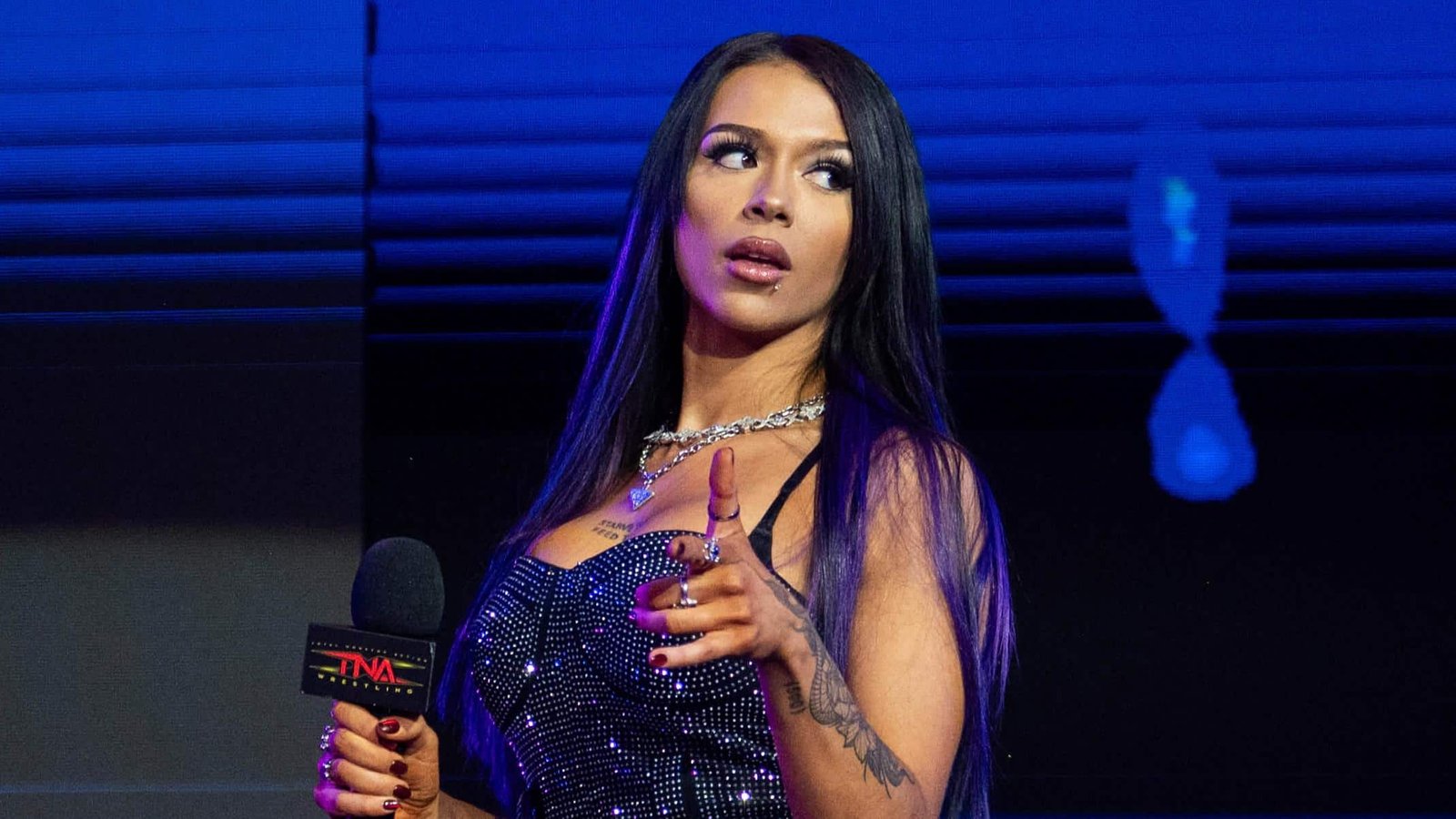
She started training at 15, signed with WWE before she’d finished working out who she was, and then did the hardest thing in wrestling, she stopped. Now 25, rebuilding at TNA and figuring out where the character ends and she begins, Elayna Black talks to Dom Smith about anxiety, imposter syndrome, Deftones, and the one musical genre she’ll never love.
There are two people in this conversation, and Brianna Coda has spent most of her life negotiating the distance between them. One of them is Elayna Black, the heel, TNA regular, five years of WWE television (as Cora Jade), a name the internet has opinions about. The other is a kid from a non-sporting background who started watching wrestling at eight and never entertained another plan.
For a long time, she says, she couldn’t tell them apart. “I started training at 15 years old, so that’s the prime age that you’re figuring yourself out,” she says. “I kind of grew up in wrestling, and because I got signed so quickly, I kind of feel like I had to grow up in the public eye.”
She refuses to frame that as a hardship. “It kind of forces you sometimes to maybe grow up a little bit quicker, or maybe see things a little bit differently that you wouldn’t have seen it had you not been in the position.” What’s changed most, she reckons, is confidence, earned slowly, unglamorously. “In the beginning, I was just a fan who happened to make my dreams come true somehow, and that still is the case. But obviously, it changes and it becomes a job. Now I’m just a lot more confident, and I feel like I’m meant to be here, and I know what I’m doing.”
“I had gotten lost in that identity”
Asked about mental health, a subject Dom raises from his own work with young people trying to break into the arts, she doesn’t reach for the diplomatic answer. “I’ve struggled with mental health as long as I can remember, as little of a kid,” she says. “I’ve struggled with anxiety and depression and things like that. So, not only having that just as a person from a very young age, and then having to deal with that on top of being in the public eye and on top of everything that the pro wrestling business brings, it can be a lot.”
Injuries had taken her out before. But the break she took a few years ago was the first she’d ever chosen. “For the first time since I was 15 years old, I took myself out (of wrestling) on purpose. I was tunnel vision since I started watching wrestling when I was eight. I wanted to take a step back and realise who I was without wrestling — because I kind of feel like I had gotten lost in that identity for so long.”
This is where the two people come back into it. “You’re playing a character, but the lines get blurred sometimes between what’s real and what’s not.” Elayna Black (as Cora Jade) had, in effect, been running for a decade with nobody thinking about Brianna Coda.
What made stepping away from the ring frightening, wasn’t only the loss of the work, it was the audience and how they reacted. “Wrestling fans are some of the most passionate fans in the world, and that is the greatest thing in the world, and also the worst thing in the world at times.”
Her defence here, is a thoughtful one: “You can’t read the internet, and if you do, you have to take it with a grain of salt. Someone could say you’re the greatest thing in the world, and someone could say you’re the worst thing in the world, and neither are true.”
Coda’s real objection to the (majority of the) fanbase is a category error they keep making. “They don’t really see the person behind the character or social media presence per se. They kind of just type, type, type and say things. But we are real people and we do deal with things.”
The wrestling break answered a question she’d been too busy to ask. “I knew if I didn’t miss it, that maybe it was time for me to move on. But the fact that I missed it two weeks after I made the post and decided to step back — I took more time than I even wanted to, just because I knew it would be best.” It didn’t just reset her. It “refined my love of wrestling.”
Her advice to anyone in the same position is refreshingly unmystical: find the thing that makes it worth it, then find the things that have nothing to do with it at all. “You’ve got to have those vices outside of whatever you’re dealing with — those things that make you have peace as a human being, which I think is more important than anything else at the end of the day.” She singles out AJ Lee, “very, very passionate about it,” and adds: “I don’t think enough people talk about it.”
Imposter syndrome
Five years at WWE, a year at TNA, and Coda still won’t call herself a veteran. “I’ve always had a little bit of imposter syndrome. I don’t ever feel like it’s my place.” She’ll always give advice when asked — “but that doesn’t necessarily mean that I feel like I should be giving it.”
Some of that is how she came up. “I had never played sports really. I played soccer for a few years. I was never a crazy athlete — I could barely do a cartwheel. I had no special talent. I was just a wrestling fan who loved wrestling and wasn’t gonna see it any other way.” Then she catches herself: “I have to remind myself that I was so passionate about this that I got here, without all of that.”
Occasionally the role finds her anyway. “I had a match recently on Xplosion. It was a four-way, and I realised I was the most experienced person in the match. So it was kind of on me to guide.” Mostly she’s still working from the first thing her trainer ever told her: “Keep your mouth shut and your ears open.”
The TNA locker room she describes as “probably the greatest locker room I’ve ever been a part of” — close-knit, family-ish, competitive in the healthiest way. “We’re watching the person’s match before us, and we’re like, damn, that was a really good match — but I’m gonna go out there and be better than you.”
Writing the character herself
TNA’s reputation for creative freedom is real, she says, and she’s grateful for it — but autonomy cuts both ways. At WWE, “a lot of things are more directed and guided… they kind of have an idea for your character maybe already.” At TNA, “I was like, oh, I have to do this all myself now.”
Which is a strange position for someone who has only just finished separating herself from the character: she now has to sit down and consciously author it. “It puts more pressure on me to create something great and decide who Elayna Black is now in 2026 and for years to come.”
There’s a craft problem underneath. She’s been a heel almost continuously — a year and a half on the indies, then WWE, with “a very short run as a babyface, maybe a year, and then I was heel again.” She hasn’t worked babyface since 2022. “Being able to play the bad guy and say the things that maybe you wouldn’t say in real life — I think that’s so much fun.” But the pivot excites her. “I’m very excited and challenged right now to see who Elayna Black is in this new light. I don’t want to say a blank slate or a fresh start, but something along those lines.”
Her framing of it is telling: “I’m very grateful for TNA to give me that opportunity to be able to decide who I am now today at 25 years old.” Not who the character is. Who she is.
Music taste
We’re a music platform, so we had to ask. She declined to be pinned down, which is the correct answer.
“My music taste is literally all over the place. My playlist is insane. If you put it on shuffle, it’ll go from a rap song to a punk song to a sad song to something random.”
The architecture: rap and hip hop at the top, “punk, alternative, rock, indie stuff” underneath. Future is the all-time number one — “his new album is all I’ve been playing right now. My lockdown gear was just inspired by him,” which makes the influence literal, stitched into what she wears to work. She’s also a serial obsessive: “I’ll find a random song on Discover Weekly, and I’ll overplay that song over and over for the next two days until I absolutely hate it, and then I’ll move on to a new one.”
At the time of writing she’s “back in my Deftones phase,” with Change (In the House of Flies) on gym duty — “that was my whole gym song yesterday.” And she doesn’t want adrenaline in the weights room so much as something to dig into. “I like to listen to sad music sometimes when I work out. I know that’s kind of weird, but it makes you pull from within and use the pain.”
There is exactly one exclusion, and she knows it’ll cost her. “I can’t do Country [Music]. It doesn’t matter if I have a drink, I’m at a party. It doesn’t matter. I can’t.”
What’s next
“I just want to say thank you to everyone who has supported me,” she says. “It’s been quite the journey, but I know a lot of you are still with me.”
And she wants hardware. “I have my eyes on some gold once again. Maggie Lee, I’m looking at you — I just beat your best friend the other night, so that’s all I’m gonna say. I feel like a title shot is in my future.”
Elayna Black appears on TNA Wrestling, Thursdays at 9pm ET on AMC — and on TNA+ in the UK. Bound for Glory takes place October 11th in Tampa.
Watch/listen to the full chat below: