



Mary Chapin Carpenter is one of those artists who sets the bar very high when it comes to recorded output. Not for her the experimental path of, say, Lou Reed’s Metal Machine Music or Neil Young’s Trans. Instead, she has devoted her musical life to the development of quality songwriting. Of course, there have been differences in her albums – the first couple of records very much show an artist in development, even as there were some great songs. However, third outing Shooting Straight From The Heart (1990) moved her to the top table with an impressive range of musical styles and storytelling lyrics, while fourth record Come On, Come On (1992) achieved the unlikely feat of shooting her to the top of the charts, while keeping her unique voice intact. The single He Thinks He’ll Keep Her especially became an anthem for female emancipation, even as it delivered its message without any sugar coating. I Feel Lucky was a sassy and funny take on not hedging your bets, while the title track was a breathtaking, empathic, and personal ballad that provided a template for much of her work going forward.
Can’t Live With It: Time*Sex*Love* (2001)
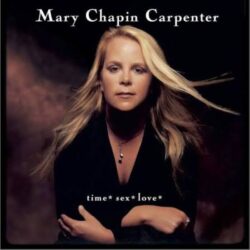 After the commercial success of Come On Come On and follow up Stones in The Road, Carpenter has said she felt pressured to continue in that vein with the subsequent release of A Place In The World (1996) – perhaps evidenced on slightly lightweight tracks such as I Want To Be Your Girlfriend and Let Me Into Your Heart; although as always, some very fine songs are also present, not least the moving title track.
A gap of five years followed before Time*Sex*Love* arrived. Perhaps it is my own British sensibility that set warning bells ringing before I’d even heard a note of it… the title itself seemed a bit like an artist standing on their own soapbox, and shouting “Listen up, World! I have words of great import to pass on to you!” Experience has shown that when artists try that bit too hard to say something profound, it can result in something less than that. (NB the title apparently comes from bandleader/co-producer John Jennings, with his quote: “Time is the great gift; sex is the great equalizer; love is the great mystery”. To which I would reply, ya-di-ya-di-ya. That’s as may be, John, but leave the words to Mary). Anyway, it’s important to note that the critic’s subjective perspective has no more value than anyone else’s. Carpenter herself has expressed satisfaction that the album was the one she wanted to make, and moved her in a more adult direction.
So, there may well be plenty of people out there who find the profundity that Carpenter sought in this record. Certainly, it should be noted that this is not an absolute dud of an album, there are plenty of songs that can stand proudly in her canon (What Was It Like and The Dreaming Road to name but two). It feels more like the overall tenor of the record is a little overblown, both in concept and in production, with too many of the up tempo numbers especially sounding musically clunky and lifeless.
Perhaps the record could be heard as a bridging work, with many fine albums following that have ploughed distinctly adult approaches to the challenges of life. However, it is a shame that the balance of earlier records, where songs with the uplift and excitement of Down at The Twist and Shout or How Do? could sit happily beside the sweet story telling of When Halley Came To Jackson or This Shirt, while always making space for the intimacy, poetry and adult themes of, say, Only a Dream or Quittin’ Time(check the live version on the Party Doll compilation for the best realisation of this – similarly for This Shirt).
Can’t Live Without It: Stones In the Road (1994)
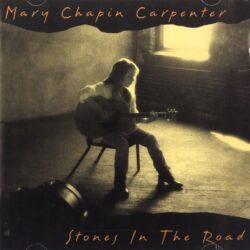 For most artists, the commercial and artistic success of Come On Come On would be the high water mark for their career. For Carpenter, she was apparently so in the zone, that the record that followed, Stones In The Road, was even more artistically impressive.
Where to start with this extraordinary record? The first thing to say, in contrast with many other ‘magnum opuses’, is that this is really a very easy record to listen to and to enjoy. Opener Why Walk When You Can Fly comes in with a delicate solo piano, before Carpenter’s a capella voice sings the opening lines. It is an uplifting message, with music that could easily be overwhelmed by overproduction, but instead stays as light as a soufflé.
The song Stones In The Road, is, quite simply, a magnificent achievement. It touches on elements of American history, on how the psyche of a generation can be moulded, and how much our lives are out of our own control. And really, it’s about so much more than that. It is the genius of the best songwriters that in a few words, they allow us to examine our own lives; and even more, that the same song can change meaning as our own lives change. Having a truly memorable chorus does no harm, either.
Then along comes Shut Up and Kiss Me – a song whose meaning is captured succinctly in its title! It’s catchy and hooky and so much fun, and shows a sense of awareness that sometimes records need a bit of light and shade, and we don’t have to disappear inside our own navel to have a good time.
As with so many great albums, the second half keeps moving forward through a myriad of moods, thoughts and emotions – and some stunning music. The Last Word is almost a pop song in its melody, but with such a whipsmart, if regretful, take on the pointless arguments that couples have when things are going wrong, as if somehow we can argue one another into submission and win a fight where in reality, there can be no winners.
John Doe no.24 is a great piece of descriptive story telling, with delicate musicianship surrounding the imaginative tale of a profoundly blind and deaf man, one of American’s John/Jane Does, the people who have no name and no known background. Carpenter tells the song like a novel, and it is easy to be both engrossed and moved.And then there’s Jubilee. With all else on this record, and all that she has done before and since, there is nonetheless a case to be made that this is her finest song. Though perhaps there is no need to rank an artist’s work as if it is a competition, so we’ll just say, it’s a wonderful achievement. No words are wasted, in this hymn to supporting each other to face the challenges of life. Every line is quotable, but we can’t really do that here. Still, a small morsel: “And I can tell by the way you’re talking /That the past isn’t letting you go /There’s only so long you can take it all on /And then the wrong’s gotta be on its own”.
It’s quite something that Carpenter chose not to end the album with this…in fact, three more songs follow. The up tempo Outside Looking In, the intimate, pensive piano ballad Where Tine Stood Still, and then This is Love…which let’s face it, is an extremely fine song, too, similar to Jubilee in its reaching out to a troubled close friend, or possibly to America and the world beyond it, and ending with a nice musical touch, a circular nod to the piano of opening track Why Walk…
Perhaps what Carpenter was deliberately aiming at with Time*Sex*Love*, she had actually already achieved with Stones In The Road. Whatever, she has continued to make some great records, allowing her music to evolve with her own age, and not trying to reach for or copy the first flights of her youth. If Time*Sex*Love* was the catalyst for this, then there is much to be grateful for; but I for one will continue to reach for Stones In The Road most regularly.
Related