

CLICK HERE TO GET A COPY OF THE NEW UNCUT DELIVERED TO YOUR DOOR
Brian Eno‘s pioneering label Opal has just been resurrected, promising reissues and even new work.
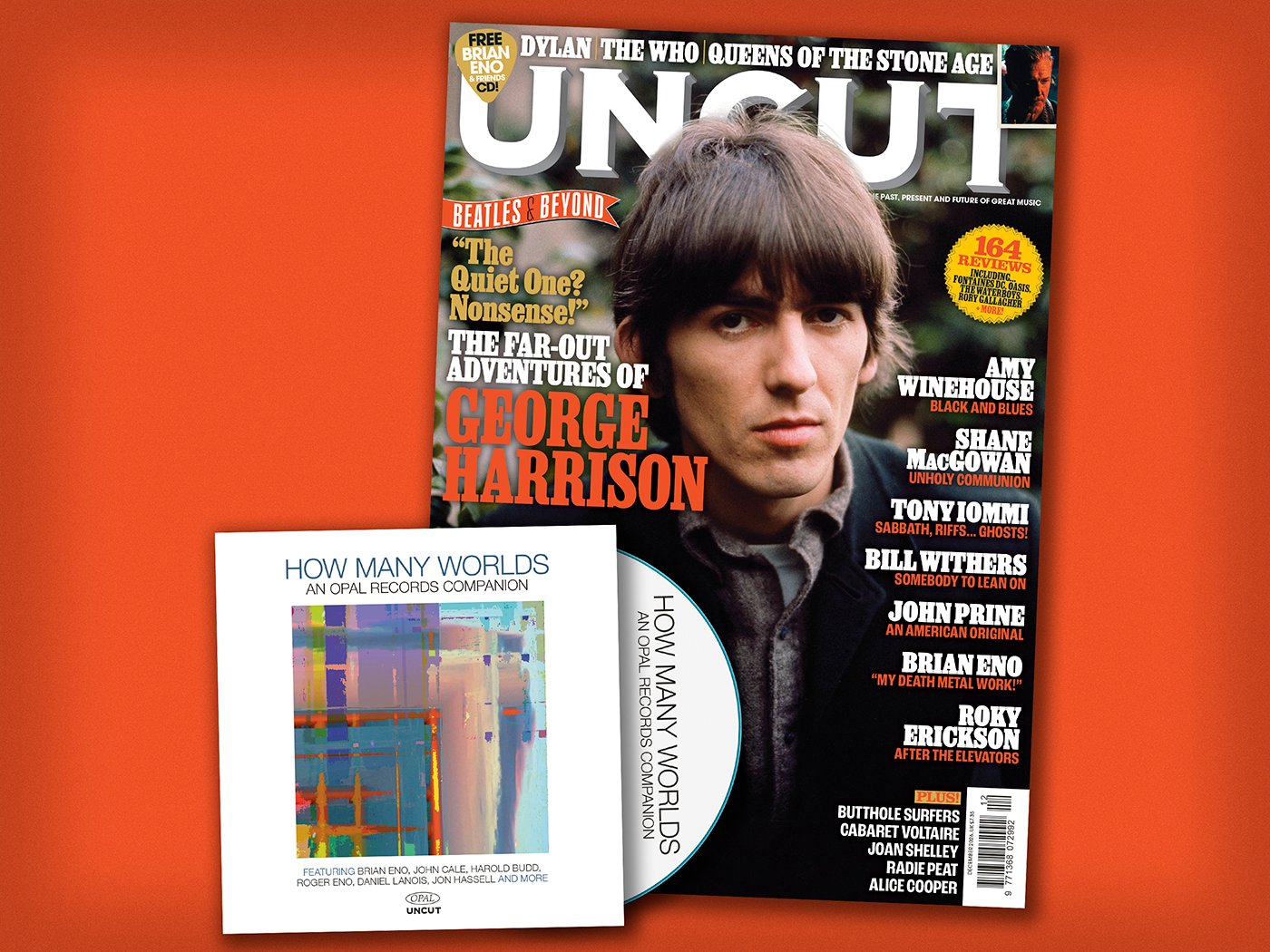
To celebrate this, our new compilation – How Many Worlds: An Opal Records Companion, available for free with the new December 2026 issue of Uncut – presents the label’s sublime, strange story this far.
Look at Brian Eno’s solo discography for the late ’80s, and he appears to be taking a break: between 1985’s Thursday Afternoon and ’92’s Nerve Net, there’s nothing. Yet he was as busy as ever, among other things, winning Grammys for co-producing U2’s The Joshua Tree, and setting up his own label, Opal, in 1988.
Like his previous operations from the ’70s, Obscure and Ambient, and the No New York compilation he conceived and recorded in 1978, Opal was intended to document a scene of musicians – mostly Eno’s friends and collaborators – making interesting music outside of the mainstream: there was Harold Budd, John Cale, Daniel Lanois, Jon Hassell and his brother Roger Eno, among others. But the label also became a place for Eno to release the work of others that took his fancy – from the Soviet Union, Djivan Gasparyan and Zvuki Mu, from America, Hugo Largo – and a home for his own music. Even when Opal finished as a proper label, it remained as an imprint for some of Eno’s own work, usually soundtracks to films or installations, such as his Rams OST, represented here.
A helpful guide, then, as we wait to see what comes next from this questing musician.
Read on for the detailed lowdown on the CD…
CLICK HERE TO GET A COPY OF THE NEW UNCUT DELIVERED TO YOUR DOOR
1 Brian Eno
How Many Worlds
We open with a highlight from Another Day On Earth, the 2005 album that reintroduced Eno as a singer of songs. It’s a landmark release, informing most of his work since, and this is its most moving moment, buoyed by a mass of strings.
2 Brian Eno & John Cale
In The Backroom
1990’s Wrong Way Up, the only collaborative album by Cale and Eno, is full of treasures to be discovered. Here’s one, a Cale-led piece that could – with a different arrangement – have been at home on the woozy travelogues of Paris 1919.
3 Harold Budd
Balthus Bemused By Color
Eno discusses Budd’s desire to make “eternally pretty music” in our feature in the issue, and his 1988 album The White Arcades is surely his dream made reality. This track begins with tranquil drones, before a delicate melody forms, almost organically.
4 Daniel Lanois
Still Water
Here’s the opening track of Lanois’ debut solo album Acadie, a brilliant singer-songwriter record that only occasionally touches on the out-there drift the musician and producer is best known for. This sublime cut evokes Lanois’ fellow Canadians Neil Young and The Band.
5 Roger Eno
Almost Dark
Between Tides was the second solo album by Eno’s younger brother, and its 13 tracks smartly predict the 21st-century neo-classical trend. It’s not ambient per se, but its piano and strings are dark, mysterious reflections of the natural world.
6 Hugo Largo
Scream Tall
This curious New York group – consisting of violin, two bass guitars and Mimi Goese’s anguished vocals – released their first work, 1988’s Drum, on Opal. Produced by Michael Stipe, the record remains rather unique, a thrilling cross between The Feelies, Slapp Happy and Brecht.
7 Brian Eno/J Peter Schwalm
More Dust
This 2001 collaboration with the German producer and composer started out as a soundtrack, but became an album in its own right: overlooked at the time, perhaps because its genre-melding electronic collage was a little ahead of its time. Here’s one of its compelling shorter tracks.
8 John Cale
The Soul Of Carmen Miranda
1989’s Words For The Dying was a spoken-word, orchestral reaction to the Falklands War, and inspired by the poetry of Dylan Thomas. Yet tucked away at the end was this entrancing song, a Cale/Eno collaboration that surely opened the door to Wrong Way Up.
9 Brian Eno
Ali Click
His first proper solo album in seven years, Nerve Net was a confusing thing in 1992. But these experiments with electronic rhythms, jazz and vocals, with guitar from Robert Fripp and Robert Quine, have aged well and now seem like precursors to Eno’s more outré work this century.
10 Jon Hassell
Tikal
After a number of classic albums exploring his own ‘Fourth World’ style of the futuristic and the ancient, the trumpet player and composer took on influences from hip-hop on 1990’s City: Works Of Fiction. The result was a collection of atmospheric letters from some humid, dilapidated metropolis.
11 Brian Eno
Designer Piano
In the years since it stopped operations, Opal occasionally appeared as an imprint for Eno’s own work. The 2020 soundtrack to the documentary Rams, about the German designer Dieter Rams, was one such case, and a highlight of Eno’s recent work.
12 Djivan Gasparyan
I Will Not Be Sad In This World
The Armenian duduk master recorded an entirely unaccompanied album for the Soviet Union’s Melodia label in 1983, and it was released in the West via Opal six years later. This is the unforgettable title track, at once mournful and celebratory.
13 Brian Eno
Riverside
For its creator, 1992’s The Shutov Assembly – recorded throughout the late ’80s – was underrated on release. Yet, as Eno acknowledges, it’s since been acclaimed as one of his finest ambient releases. It’s hard to pick a highlight from these 10 gems, but “Riverside” is as good a place as any to start.
CLICK HERE TO GET A COPY OF THE NEW UNCUT DELIVERED TO YOUR DOOR