

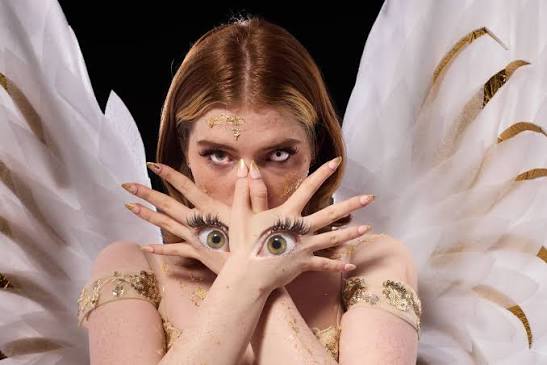
There’s a moment near the end of my conversation with Brooke Ellen where she describes the ending of her debut LP, and it lands like a thesis statement for everything that came before it. Her two characters, separate entities across her earlier singles, have merged into one, fought their way through the parts of themselves they believed were broken, and arrived somewhere unexpected: “at the end, they kind of come to an agreement that it’s not – nothing about them is wrong, and it’s products of their environment.”
It’s a cool trick, that. Wrap a very human realisation, that the things you were taught to hate about yourself were mostly circumstance, inside a fantasy world of characters and lore, and suddenly it’s something a listener can hold at arm’s length long enough to actually look at it. That’s the Brooke Ellen method in a sentence, and it’s why the Liverpool-raised, Manchester-based artist has become one of the more genuinely interesting propositions in the emerging pop landscape.
Two Cities
Brooke grew up in Liverpool and moved to Manchester for university, and she’s open about what that did to her. “There’s so much culture and expression here,” she says. “I grew up in Liverpool and I moved to Manchester for university, and especially those two cities have had such a huge impact on who I am as a person, and what my creativity and what I kind of lean into”.
She name-checks LUVCAT as a fellow Liverpool export, but her point is less about lineage than atmosphere. Both cities, she reckons, are “very much expressive and full of people who allow you to express”, and that permission structure is what she keeps returning to. “I found such a good support system that allow me to be who I want to be and create what I want to create.” Ellen’s changed enormously in the past couple of years, she says, and she credits the cities themselves: “I owe a lot to the cities and the culture that they have as well.”
Having spent a fair amount of time around Manchester and wider North West scenes, I’d add a less romantic observation to hers: there’s a work ethic baked into this region that you don’t find everywhere. Bands and artists here tend to understand the importance of grafting. Brooke has built a properly coherent brand around herself, and that doesn’t happen by accident, which is a thread we pick up later.
The Weird and Wonderful Era
“I think the media I consumed really inspired me,” she says. “So things like, I grew up a lot around Monster High and that kind of era of things, and the era where people were starting to become more expressive and, like, even things as silly as dolls. Dolls were becoming more expressive and more unique and more weird and wonderful.”
That phrase, weird and wonderful, recurs throughout our conversation. It’s the aesthetic register she was raised in, and it maps directly onto the goth-adjacent imagery she now pairs with pop melodies.
On the lyrical side, the influences are more conventionally identifiable. Marina and the Diamonds and Alec Benjamin are the two she flags as formative, the artists who taught her “to really take that kind of storytelling arc with my music.” Sonically, it’s Melanie Martinez, Halsey, and, as the landscape shifted, early Billie Eilish, who she cites as evidence of the culture turning: “that’s what I mean by the media to kind of take in that turn and having that whole different perception on what was cool, because things like that were kind of really out of the box.”
But the most revealing answer is the one about scenes rather than stars. She grew up inside the Nightcore and Gacha communities, online subcultures built around sped-up, pitch-shifted edits of existing songs and animated storytelling. She mentions smaller artists too, like Ellise, whose track “911” she says “went platinum in my household. I played that every day.”
“A lot of my inspiration came from not really even specific artists, but the general media and the culture that I was involved with at the time, and the music that was going on in those bubbles, those circles.”
That distinction matters. Brooke Ellen isn’t an artist assembled from a list of Spotify-adjacent reference points. She’s the product of a specific corner of the internet at a specific moment,and as we’ll see, she’s still actively in dialogue with it.
Imagery
Plenty of artists treat visual identity as an obligation. I wish I could just focus on the music. Brooke is emphatically not in that camp.
“I really love imagery, and I really love the stories that I create with them,” she says. She’d been on a livestream with fans the day before we spoke, and they’d spent it “talking about the lore and the story behind the characters that I have created in my music”.
Her reference points here widen from Monster High to Alice in Wonderland, “just weird and wonderful fantasy worlds.” And the reason she cares so much is stated plainly: as a kid, those worlds were shelter.
“Having those safe spaces was really important to me, and really important to nurture the creativity I had and nurture me as a person and who I wanted to become. So being able to do that now with imagery, and with the media that surrounds the music that I make, is one of the most important things about my music.”
This is where the project she’s currently finishing comes in. Seven Deadly Pages, several singles from which are already out, takes the characters she’s developed and merges them into a single entity that has to “fight their way through what they believe is parts of themselves that are wrong.” The resolution, as above, is self-acceptance arrived at through understanding environment rather than blame: “how you kind of cope with that, and it’s been a really cool concept to explore.”
Fragile Mind
Go back to 2022 and Fragile Mind, and you find a noticeably different artist. I ask her how she views that period now. “That era of myself was really a kind of figuring-out era,” she says. “I feel like the real story of Brooke Ellen, it did start in the Fragile Mind era, with Try Harder and things like that. But that part of my music was very much me trying to figure out who I was and figure out who I wanted to be musically”.
The crucial context: she was fifteen when she started recording and writing. “I didn’t really know who I was yet, and it was a really evolutionary period for me, where I came out the other end with such a clear idea of what I wanted to do.”
What changed wasn’t the goal. Connection was always the goal. What changed was the route. “I came out the other end of that with such a clear view of how to do that — and not just the what. It was more of the why and the how that I figured out.”
There’s no embarrassment in how she talks about it, which is rarer than it should be in artists revisiting teenage work. “I hold nothing but love for it. But it’s so fun to also see how far I’ve come from that.”
The DIY Engine
Here’s the thing that most impresses about Brooke Ellen, and it’s a slightly unfashionable one to praise. She books her own shows. She generates her own opportunities. There’s a school of thought in music that says you shouldn’t do this, wait to be booked, wait to be discovered, wait for someone with a business card to decide you’re ready. Brooke, who also works in the industry via Play One We Know, doesn’t wait.
But she’s careful to reframe self-starting as community-building rather than solo heroism. “A lot of that I’ve got to hand to the community that I’ve built around myself,” she says. There’s a close friend at Vessel Studios (Liverpool) who handles the media side, “all of the filming we do together, and all of that visualisation world really comes from our two heads.” Her partner works on special effects. Her producer came recommended through her management. Promoters and other bands form a mutual-support layer around all of it.
“We’re all a really tight-knit community, and I feel so incredibly fortunate to have that community who only ever want to give support, only ever want to give love and the time to help me build this world that I’m trying to build.”
That extends to Play One We Know (POWK), where she spoke to founder Gerard (Gibbons or Toplass, there are two – we didn’t ask…) about the platform before she ever began working with them. Then the line that punctures any notion that polished output equals institutional backing: “The streaming numbers and the ticket sales and everything like that all comes from just so many amazing people who put so many hours in. My band put so many hours in with me to make sure our sets are perfect, and my producer puts so many hours in with me to make sure that the songs that come out are perfect, and my management puts so many hours in to find other contacts and find opportunities.”
She’s clear that this network didn’t just materialise. “I’ve really pushed to find that community, and I’ve really put myself out there to find these people.” The reward is an ecosystem that’s “constantly giving you good energy and good vibes.”
The Desk of Gifts
Ask Brooke about her supporters and the register shifts immediately. “My supporters are incredible, incredible people,” she says. “And I say this all the time, they are the backbone to what I do, and I wouldn’t be anywhere without them”.
Her favourite things are the objects handed to her at shows. One sits on her desk in front of her as we talk. There’s a whole display of them. “I keep them all really close to me and really close to my heart.”
What moves her most, though, is hearing the mechanism work in reverse, fans using her music the way she once used other people’s. “Giving that space and that creativity to other people, because that’s really what I thrived on growing up.” She admits to being “such a big sap”: there have been gigs where fans have cried, or started freaking out, and she’s joined them. “Hearing how it makes my fans feel is the most extraordinary thing.”
Sped-Up Songs
Sped-up edits of “Ex Best Friend” and “Itch” have racked up hundreds of thousands of streams — considerably outpacing the originals. In the current industry, that’s often a cynical TikTok play. For Brooke it’s genealogy.
“I literally couldn’t tell you why,” she laughs. “I very much grew up in the Nightcore community, and that’s what sped-up versions were called when I was younger. But I couldn’t tell you why speeding them up was a thing, or why it was a thing that people enjoyed. It just was.”
Crucially, this is how she discovered her own influences: “All of the songs that I found of Alec Benjamin’s, “were all sped-up versions I found online.” The community self-propagated. Songs got sped up, songs that sounded like those songs got sped up, and a genre emerged from the process.
She describes a recurring argument with her girlfriend, where a track comes on and Brooke insists it was a Nightcore song. “And she’d be like, ‘No, it wasn’t, it was from X, Y and Z.’ And I was like, ‘No — I know that from the sped-up version from 2017.’”
The nostalgia of it slightly alarms her (“which is terrifying for me”), but the intent is sincere: “paying homage to those who came before me.”
A Safe Space for the Odd Kid
Asked what she’d say to listeners who haven’t found her yet, she doesn’t reach for a slogan. “Growing up, and I don’t hide this fact at all, I was a pretty odd kid. I didn’t have many friends. I didn’t really have anyone to speak to or anyone to process my feelings with. So I did that a lot through music and the media that I had, and especially through lyrics.”
Relating to an artist, she says, was “such an important factor” in getting through adolescence without feeling alone. So that’s the offer: “I want my space to be somewhere that they can be themselves, and they can process their emotions with me, and connect with me, and feel that kind of love that they deserve to feel.”
What’s Coming
The remainder of 2026 is busy. Seven Deadly Pages, over a year in the making, arrives by the end of the year. “It doesn’t feel real that it’s coming out,” she says. Her next headline show will be announced before year’s end, and there are further opportunities she describes as “all very tight and under wraps”.
Her own parting instruction: stream “Skin on the Mirror” and pre-save “Waiting Again”.
One suspects there’s a part two to this conversation waiting, the full lore, the complete character map. For now, it’s enough to note that Brooke Ellen has done the hardest thing an emerging artist can do: worked out not just what she’s making, but why.